

- A war is brewing between two of Australia’s most notorious bikie gangs
- The Rebels’ run to Melbourne over the weekend faced intense police scrutiny
- One top cop warned their run came amid rising tensions with the Comancheros
- He described the rise of incidents between them as driven by ‘greed and power’
A hundred-strong Rebels meet-up is the start of a new crisis between two of Australia’s most notorious bikie gangs, a top cop has warned.
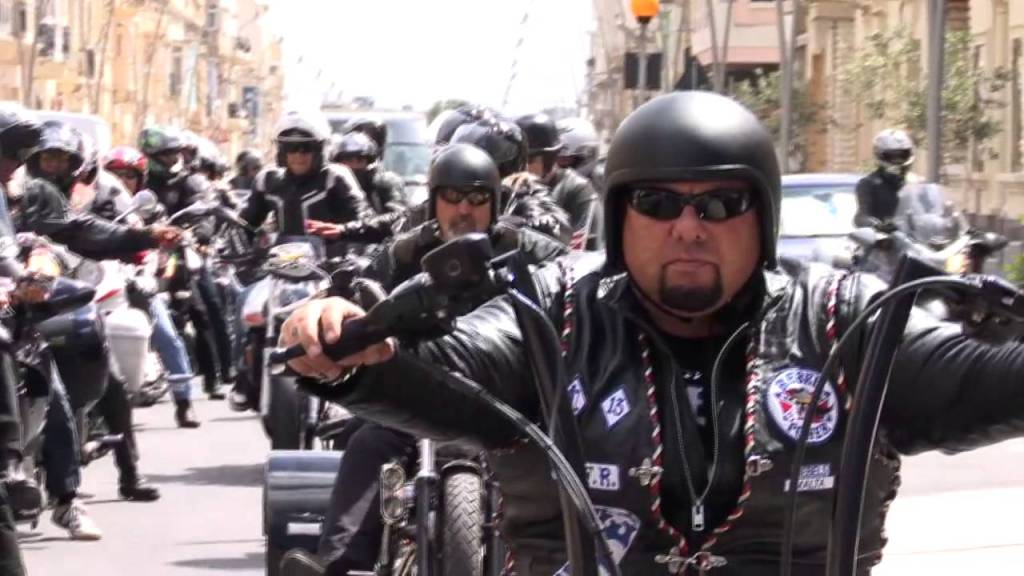
Police formed a ring of steel around the Rebels clubhouse in Melbourne at the weekend as they celebrated the 20th anniversary of their Victoria chapter.
Armed police officers along with the Public Order Response Unit monitored the Rebels’ base throughout the weekend, located in Sunshine West 15km from Melbourne’s CBD, and forced members through rigorous vehicle and bag searches.
While the weekend event passed without police reporting any arrests, West Australian police commissioner Chris Dawson said tensions between bikie gangs were on the increase.
He told Perth’s 6PR radio station on Friday: ‘We’ve got some warnings out for our officers to take particular care because these tensions are emerging.’
‘What concerns me and should concern the community is when firearms are being used out in public, as we’ve seen, and people being injured.’
Mr Dawson described the gangs as criminal operations driven by ‘greed and power’.
They’re involved in drug distribution, extortion and a whole range of matters.’
He added that while 12 bikie gangs in the state were under police radar, the tension between the Rebels and the Comancheros was the biggest concern.
His words of warning came after a Perth court heard earlier this month members of the two gangs had ‘bash-on-sight orders’ against each other.
The rivalry between the groups in the West Australian capital came to a head last month in a drive-by shooting in the southern suburb of Calista.
WA Police suspect the bitter rivalry was also behind a spate of fire-bombings in Perth between March and September.
The state’s bikie warfare had already led to the conviction of 300 bikies for crimes carrying prison sentences of more than five years.

Rebels members donned branded black and white shirts commemorating their slain fellow members at the celebration over the weekend.
One member was photographed wearing a shirt which read ‘Rest in Peace Simon Rasic, Mickey D and Matty King’ – all late members of the outlaw motorcycle gang.
Simon Rasic – who was known as ‘The King’ – was sergeant-at-arms of the Rebels.
Rasic held one of the lead positions within the Rebels for more than a decade, overseeing around 2,000 gang members from Australia, New Zealand, Fiji and Malta.
At the time of his death from natural causes, Rasic, 43, was tipped to become the motorcycle club’s national president.
The father-of-four had been a member of the gang for 20 years.
His son Alex has kept close with members of the gang and leads a luxurious life filled with designer clothing, exotic holidays and expensive purchases such as planes as well as boats.
Michael ‘Ruthless’ Davey – also known as the Prince of Penrith – was assassinated outside of his home in Sydney’s west on March 30, 2016.
Only months ago, Alex took a trip to Perth with infamous bikie Chris Rymer.
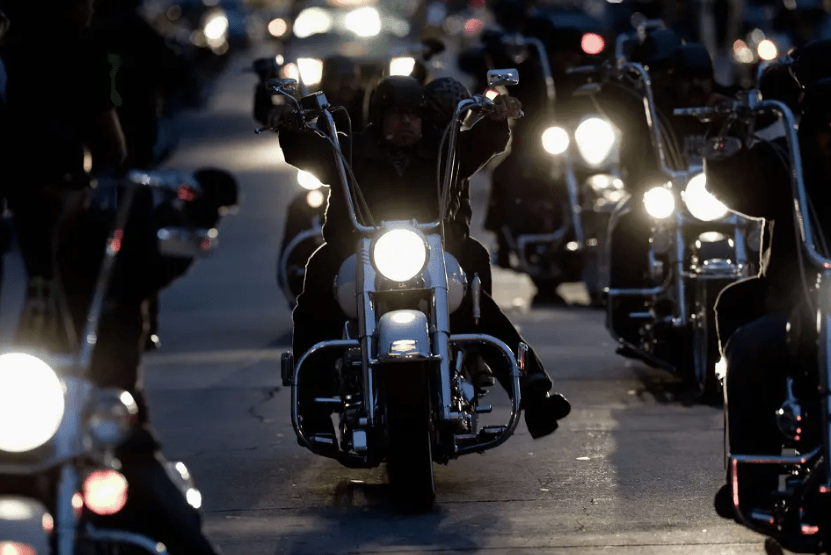
On Saturday, a series of Harley-Davidson convoys blazed up and down the highway outside their industrial unit base ahead of the Melbourne-based celebration.
Bikies seen gathered at the site, located in an industrial area 15km outside of the CBD, appeared to be under strict instructions not to talk to the media.
One member of the notorious gang told Daily Mail Australia he was looking forward to a weekend away with his friends.
Those inside the Fairbairn Street base looked like they were in the mood to celebrate, with one member driving a car loaded to the roof with beer into the building in the middle of the afternoon.
‘We’re just here to have a good time and catch up with mates we haven’t seen in a while,’ he said.
Scores of gang members travelled across the country – some as far as Western Australia – for the weekend event with fellow Rebel bikies.


 INSANE THROTTLE
One response to “Bikie war brewing: Top cop warns hundred-strong Rebels meet-up in Melbourne is the start of a new gang crisis as tensions threaten to boil over”
[…] Bikie war brewing: Top cop warns hundred-strong Rebels meet-up in Melbourne is the start of a new ga… Junior had some contact with a guy in the Vagos’ Hollywood chapter named Chuck [names have been changed], a short, beer-bellied dude with black-framed glasses. He wore a painter’s cap with the brim flipped up, had ink from neck to toes, and ran a tattoo shop in West Hollywood. Junior started hanging around there, and he was a good CI—showed up on time, took license plate numbers, eavesdropped, reported back to me. In fact I’d seen him a few hours before the accident, at a bar on the Strip where he gave me some information and I gave him some cash. I was sitting in my office downtown the day after Junior died when his girlfriend called. I offered my condolences and hung up, wondering if I was screwed. “Junior must have talked about me,” I thought. Did his girlfriend know any of the Vagos he’d been hanging around with? Did he tell her he was working with ATF? If the same thing happened today, I’d call of the operation. But I was young, and ATF hadn’t done many of these biker gang infiltrations; there wasn’t a lot of official protocol. So I decided I’d pay Chuck a visit. GRILLED I parked my bike outside the tattoo shop. I knew what Chuck looked like from the sherif’s department’s binders, but I had to fake it and ask for him inside. I introduced myself as Koz, which is my real nickname—short for Kozlowski—but I figured if anyone asked, I could say that it was short for “Kamikaze” because of how I rode my Harley or some bullshit like that. I wanted a name that I responded to instinctively. I told Chuck I was a buddy of Junior’s, that I knew he’d been hanging around the Hollywood Vagos, and that I had some bad news. Chuck knew about the crash on the Strip but not that Junior was involved. We talked for a while, and he told me to come back in a few hours. When I showed up again, Chuck got on his bike and had me follow him east to their clubhouse—basically a two-level cinder-block warehouse at Hollywood and Kenmore—where I rode in and somebody locked the chain-link gate behind me. There were about ten guys, their bikes all lined up. Chuck introduced me. “Wait here,” he said and went in the building with the other guys. An hour or so later, someone came out and called for me. “Get in here.” As I walked inside, this heavily fortified metal door slammed behind me, and they patted me down for a wire. Now I’m scared shitless, locked in a windowless building with a bunch of outlaw biker dudes who were very likely convicted felons. I had no cover team, and I didn’t have much in the way of what we call a “backstop”—a story about who I am or what I do for a living, though I was at least carrying a driver’s license and Social Security card under my alias. […]
LikeLike