


SANTA ANA, Calif. (CN) — A defense attorney for the Mongol Nation motorcycle club told a California jury Tuesday that federal prosecutors had not presented any evidence that the club ever violated racketeering laws or engaged in a conspiracy — indeed, he said, it could not be convicted of conspiracy because an entity cannot conspire with itself.
“There’s no evidence that the Mongol Nation conspired to do anything,” Joseph A. Yanny told the Orange County jury in his closing arguments.
“There are individual members” who have committed crimes, he acknowledged, but “there’s no evidence at all that the club joined in those activities.”
He said the club itself cannot be held liable for “isolated incidents committed by boneheads.”
Yanny described the prosecution of his client — which began with undercover investigations going back 20 years — as persecution of the largely Latino club by corrupt agents of the Bureau of Alcohol, Tobacco, Firearms and Explosives. He implored the jury to “send a message that this type of prosecution against these men has got to stop.”
Assistant U.S. Attorney Christopher M. Brunwin countered that the Mongol Nation as a body encourages and rewards crime. “They are a violent organization that attacks people, that kills people and that distributes drugs,” he said during rebuttal.
“This is what they do,” Brunwin said as he displayed a photo of a man beaten to death by Mongols. “This is what they brag about. This is what they’re proud of.”
He said the Mongol Nation even rewards members who kill people on its behalf with special patches to sew onto their biker vests, including one he called a “murder patch.” It shows a skull-and-crossbones with a capital “M” on the skull’s forehead.
He scoffed at Yanny’s explanation that the M merely stands for Mongols.
Brunwin and co-counsel Assistant U.S. Attorney Steven R. Welk charged the Mongol Nation, as an “unincorporated association,” with violating the Racketeer Influenced and Corrupt Organizations Act and conspiracy to commit racketeering.
They have not charged any individuals with crimes. As Yanny told the jury at the beginning of the trial, “No one is going to jail out of this trial.”
In a 2008 case, however, 79 Mongols and associates pleaded guilty to racketeering and other crimes.
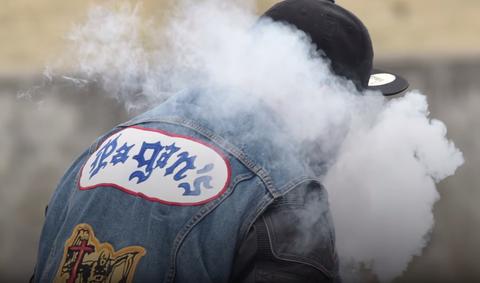
A major goal of the current case is to seize, through criminal forfeiture, the gang’s trademark to its distinctive main patch, which full members wear on the back of their vests. The design shows the word “Mongols” in an arc above what has been described as “a cartoonish depiction of a Genghis Khan-like character” riding a motorcycle and waving a sword.
If the prosecutors succeed, “no member of the gang would be allowed to wear the trademark that we believe is synonymous with the group,” a representative of the U.S. Attorney’s Office has said.
Prosecutors are also seeking a fine and forfeiture of the club’s assets.
A significant but technical legal issue facing the jury is whether the Mongol Nation as an entity can be guilty of racketeering and conspiracy to engage in racketeering with itself.
Under the federal RICO Act, a “person,” including a corporation or association, can be charged with a crime only for engaging racketeering activities with an “enterprise.”
Brunwin and Welk say that criminal enterprise is the larger Mongol biker gang, of which the formal Mongol Nation is only a piece.
At one point in the case, U.S. District Judge David O. Carter ruled that “there is no meaningful distinction” between the two, but he was reversed in July 2017 by the Ninth Circuit.
On Monday morning, Carter instructed the jury that prosecutors must prove the Mongol Nation and the Mongol gang are distinct entities. The Mongol Nation cannot be guilty of racketeering, the judge said, if there is only one entity.
Therefore, Yanny later told the jury, “If you find that there is no distinction, we can all go home. You just find the defendant not guilty.”
After all, he argued, “Where did you hear testimony that the Mongol Nation is separate from the Mongol gang? I don’t remember any testimony like that during the government’s case.”
In his closing argument Monday, Welk argued that only Mongols who have risen through the ranks to earn the right to wear the complete insignia patch on their vests are members of the Mongol Nation. Citing the group’s detailed, written constitution, he said that other associates, prospects and “hang-arounds” are only part of the gang but not “full-patch” Mongols.
Yanny scoffed at the distinction. “They’re all members; they’re just members with different degrees of rights and responsibilities,” he said. “They all pay dues,” and they all owe loyalty to the club.
Although they can’t vote on club business, men in the process of earning a patch do attend the group’s meetings to assist the full-patch members by guarding the motorcycles and running errands.
Brunwin countered that the Mongol Nation is a legal person because it can, and does, own property, specifically its trademarks in the patch design. Other members of the broader gang have no property interests in the trademarks, he said.
The prosecutor spent most of his rebuttal, however, recalling evidence of several violent crimes attributed to Mongols, including the murder of a Hells Angels leader in San Francisco, beatings and knifings of enemies or men they believed had insulted them, and a deadly brawl between a large number of Mongols and Hells Angels in Laughlin, Nev., in 2002.
“Is this an organization that conspires to commit murder?” Brunwin asked. “You bet it is, and you heard it over and over” from witnesses and from Mongols themselves in audio and video recordings played during the five-week trial.
He ended by recounting again for the jury the death of local police officer Shaun Diamond, allegedly killed when Mongol David Martinez fired a shotgun as police broke down Martinez’s door at 4 a.m. in October 2014 to serve a search warrant. A slug from the shotgun entered the back of Diamond’s head and came out through his mouth as his partner watched, Brunwin said.
The jury began deliberating early Tuesday afternoon.



 INSANE THROTTLE
3 responses to “Mongols’ Defense: A Club Can’t Conspire With Itself . The Jury has the case #SAVETHEPATCH”
[…] Mongols’ Defense: A Club Can’t Conspire With Itself . The Jury has the case #SAVETHEPATCH Many of these early clubs sported full dressers and the idea or “image” that we might associate with Outlaw Clubs would become more prevalent in the mid to late 1950s. In just a 5 year span, the names to be born are legendary. East Bay Dragons, Chosen Few, Richmond Road Runners, and LA’s Defiant Ones. By most accounts, the Fresco Rattlers in early 1955 were the first Outlaw style black Motorcycle Club, preferring more stripped down versions of a Harley over the full-dresser. Late 1955 would also mark the first appearance of the Richmond Road Runners, and not long after, one of the most continuously operated Black Clubs would come out of the Watt’s section in LA, The Defiant Ones, known as the DOs. The Club’s motto is “The Power of Togetherness” John McCollum , known as PeeWee, was one of the godfathers of black biker culture in Los Angeles, a founding member of The Defiant Ones, and served as the President of The Defiant Ones for many years. Today the Defiant Ones still hold an open house every friday with drinks, food, dancing and brotherhood. The Fresco Rattlers came out of San Francisco and were founded by James “Heavy” Evans. The Rattlers were originally an all black motorcycle club, but like the Defiant Ones, would become a mixed-race Club. They had a Clubhouse in the FIllmore district of San Francisco and were early day party associates of the legendary Tobie Gene Levingston. The Rattlers were known on occasion to either party with, or mix it up with, other established San Francisco Clubs like the Hells Angels and Gypsy Jokers. I always enjoy doing articles like this, because while some of the stories of Tobie, Cliff, Lionel Ricks, Ben Hardy, Bessie Stringfield etc, are well known, or maybe something we’ve heard briefly before, getting a chance to learn more, and go more in-depth is always something i want to be able to do. Never stop learning. Never stop appreciating every drop of history you can get your hands on. If you can, please conserve and preserve this history within your own Clubs. […]
LikeLike
[…] Mongols’ Defense: A Club Can’t Conspire With Itself . The Jury has the case #SAVETHEPATCH “Around 4:00 p.m., he tells me that it is 4:00 p.m., and it is time for our beer,” Bob said. “He gets his Coors Light from the garage beer fridge and enjoys a nice cold one.” “The bluer the mountains are on the can, the better,” Bob added. Andrew, a WWII Air Force Veteran, served as a nose gunner on the B24 Liberator and top turret gunner on the B17 Flying Fortress. He also trained new pilots that were transitioning from 2-engine to 4-engine planes during the war. And he still tries to be as independent as possible. Bob noted his father has macular degeneration, but until he moved back in with him in 2016, Andrew was still cutting 0.6 acres of grass by himself and shoveling snow off his long driveway in the winter. “But now I do all of that for him,” Bob said. “The move was well worth it since I am here with him. I would not miss it for the world!” Bob said he has reached out to MillerCoors to tell them about his father’s fandom, but has not yet heard back. Andrew is not the only elderly fan of the beer company — 100-year-old Clotilda Kort chalks up her longevity to her daily Miller 64 ritual, enjoying the brew each day at 2 p.m. […]
LikeLike
[…] Mongols’ Defense: A Club Can’t Conspire With Itself . The Jury has the case #SAVETHEPATCH […]
LikeLike